Azərbaycan
  Русский
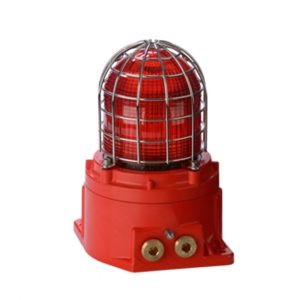
 GNEx
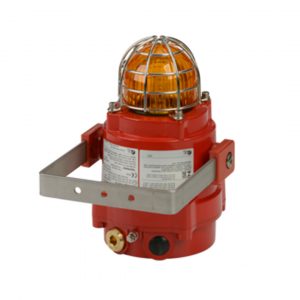
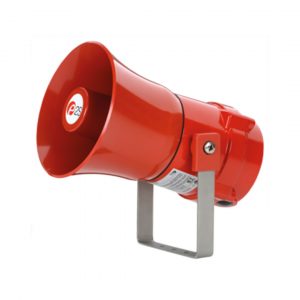
Lightweight, corrosion-resistant GRP explosion-proof sounders, beacons, combined units and call points for onshore and offshore hazardous areas.
e2S explosion-proof sounders, beacons, combined alarm-strobes and call points for hazardous areas — supplied, specified and installed in Baku for projects across Azerbaijan.
 Supply · Installation · Service in Azerbaijan
An alarm is only useful if people notice it. On a process deck with compressors running, in a turbine hall, or in a storage area in a hazardous zone, that is harder than it sounds. e2S Warning Signals, based in London, designs sounders and beacons for exactly these places, with certification for explosive atmospheres and for marine use.
ZE-Tronics supplies e2S equipment in Azerbaijan and, more importantly, helps choose it. An underpowered sounder, a beacon rated for the wrong gas group or a signal hidden behind a pipe rack does not fail on paper — it fails when it is needed.
e2S divides its hazardous area range by enclosure material, and the choice matters in practice:
Combined units put a sounder and a beacon in one enclosure, which halves the number of cable entries and mounting points. Manual call points and junction boxes complete the system.
Three questions decide most e2S selections:
We prepare alarm layouts for noisy areas, check each device against the area classification, supply original equipment with its documentation, and install it with the correct cable glands and earthing under our installation and commissioning service. At handover we record sound levels at the working positions, not just at one metre from the horn.
e2S signals are used across our oil and gas, marine and offshore and industrial projects, usually alongside Det-Tronics or Autronica detection. To get a quote, send us part numbers or an alarm schedule.
Lightweight, corrosion-resistant GRP explosion-proof sounders, beacons, combined units and call points for onshore and offshore hazardous areas.
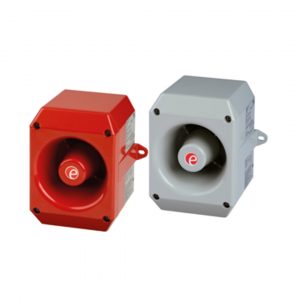
Aluminium explosion-proof (Ex d) alarm horns, xenon and LED beacons and combined alarm-strobes for demanding industrial sites.
Stainless steel explosion-proof signals for corrosive and offshore environments where a metal enclosure is specified.
Heavy-duty, high-output sounders and beacons for industrial and marine areas that are not classified as hazardous.
Low-power sounders and beacons for use on intrinsically safe circuits.
Manual call points, junction boxes, status lights and mounting accessories to complete an alarm system.
Fire and gas systems fail at the handover points between vendors. We own every step, so there are none.
ZE-Tronics supplies e2S warning signals in Azerbaijan. Send us the part numbers or tell us the area classification, required sound level and light output, and we will quote the right models with their certificates.
It needs to be clearly audible above the background noise where people are working. A common rule is at least 10–15 dB above ambient, and noise drops by about 6 dB each time the distance doubles. In very noisy areas, sound alone is not enough and beacons are added. Our guide to choosing sounders and beacons explains the calculation.
All three are explosion-proof ranges. GNEx uses glass-reinforced polyester, which is light and does not corrode; BEx uses an aluminium enclosure; STEx uses stainless steel. The choice depends on the environment, the specification and the mounting.
LED beacons have a long service life and low current draw, while xenon strobes give a very bright, short flash. The deciding factors are the required light output, power budget and maintenance access. We compare effective light output rather than joule ratings alone.
Usually yes. Most e2S signals accept standard DC or AC supplies and can be switched by relay or panel outputs, and many models offer multiple tones or stages. We check voltage, current and monitoring requirements before supply.
Send us a model number, a datasheet or an equipment list. Our engineers reply within one business day.
Contact a safety engineer