Azərbaycan
  Русский
 Gaseous Fire Suppression for Server Rooms and Control Rooms: Clean Agent, Inert Gas or CO2?
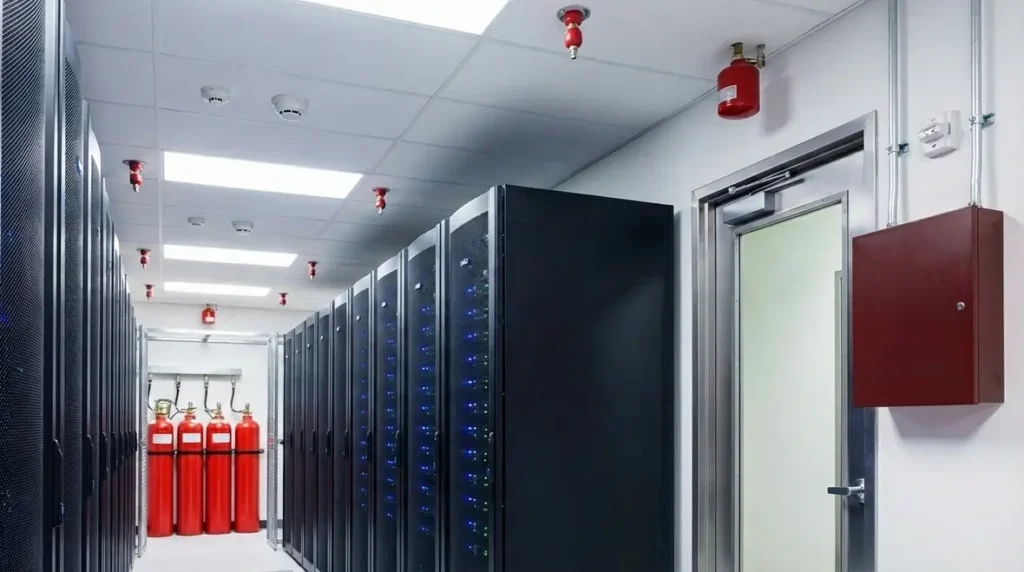
In a server room, a control room or an archive, water can do as much harm as the fire. Gaseous fire suppression puts the fire out without wetting anything — but only if the right agent is chosen, the room holds the gas, and the release is controlled safely.
Three families of agents
Clean agents (halocarbons)
Agents such as FK-5-1-12 and HFC-227ea extinguish mainly by absorbing heat. They are stored as liquids, need relatively little space, and at normal design concentrations are used in rooms that can be occupied, within the safety margins set by the standards. HFCs are being phased down internationally, so check long-term availability before specifying one.
Inert gases
Inert gas systems use naturally occurring gases — argon, nitrogen, or blends of them, sometimes with a little CO2 — to lower the oxygen concentration below the level that supports combustion, typically to roughly 10–13%. They leave no residue and have no environmental impact, but need more cylinders and space, and rooms need pressure relief because a large volume of gas is discharged.
Carbon dioxide (CO2)
CO2 is very effective and relatively inexpensive, but the concentrations needed to extinguish a fire are lethal. It is therefore used for normally unoccupied spaces — machinery spaces, turbine enclosures, some industrial processes — with lock-out devices, pre-discharge alarms and strict entry procedures.
Comparison
| Clean agent | Inert gas | CO2 | |
|---|---|---|---|
| Mechanism | Heat absorption | Oxygen reduction | Oxygen displacement and cooling |
| Occupied spaces | Yes, within design limits | Yes, within design limits | No — unoccupied only |
| Storage space | Small | Large | Medium |
| Pressure relief | Usually needed | Needed | Needed |
| Typical use | Server rooms, control rooms, archives | Data centres, occupied technical rooms | Machinery spaces, turbines, processes |
The room is part of the system
A gaseous system must reach its design concentration and hold it long enough to extinguish the fire and prevent re-ignition. That depends on the room:
- Integrity test. A door fan test measures leakage and predicts hold time, as described in ISO 14520 and NFPA 2001. Unsealed cable penetrations and false floors are common failures.
- Pressure relief. Discharge changes room pressure quickly; relief vents protect walls and ceilings.
- Ventilation shutdown. HVAC dampers and fans must close or stop before discharge.
Detection and control
Release is normally controlled by a dedicated extinguishing control panel built to EN 12094-1. A typical sequence:
- First detector in alarm — local alarm, staff alerted.
- Second, independent detector confirms (coincidence detection) — pre-discharge warning starts, doors and HVAC are controlled.
- Time delay counts down, with hold and abort buttons available.
- Agent is released; “gas released” signs illuminate outside the room.
Aspirating smoke detection is often used as one of the detection inputs because it gives the earliest warning — see our ASD guide. Manual release points and, for CO2, lock-off devices for maintenance complete the system.
Maintenance
- Regular inspection of detection, control panels, releasing devices and warning signs
- Cylinder pressure or weight checks and agent quantity verification
- Periodic room integrity re-testing, especially after building works
- Cylinder recertification according to the applicable pressure equipment rules
How ZE-Tronics helps
We design and install complete gaseous suppression systems with Kidde equipment and Kentec extinguishing control panels, carry out room integrity tests, and maintain systems over their life. See fire alarm system types or send us room details for a proposal.
Frequently asked questions
Is gaseous fire suppression safe for people?
Clean agent and inert gas systems are designed for spaces that may be occupied, within the limits set by ISO 14520 and NFPA 2001. CO2 at extinguishing concentration is lethal and is used only in normally unoccupied spaces with strict safeguards.
What is a door fan test?
A room integrity test that uses a fan in a doorway to measure leakage and predict how long the room will hold the extinguishing concentration.
Why are two detectors needed to release the gas?
Coincidence detection reduces the risk of an unwanted discharge caused by a single faulty or contaminated detector.
How often should a gas suppression system be serviced?
Inspections are typically carried out at least twice a year, with room integrity re-tests after building works and cylinder recertification according to pressure equipment rules.