Azərbaycan
  Русский
 Fire Detection and Suppression for Waste and Recycling Facilities
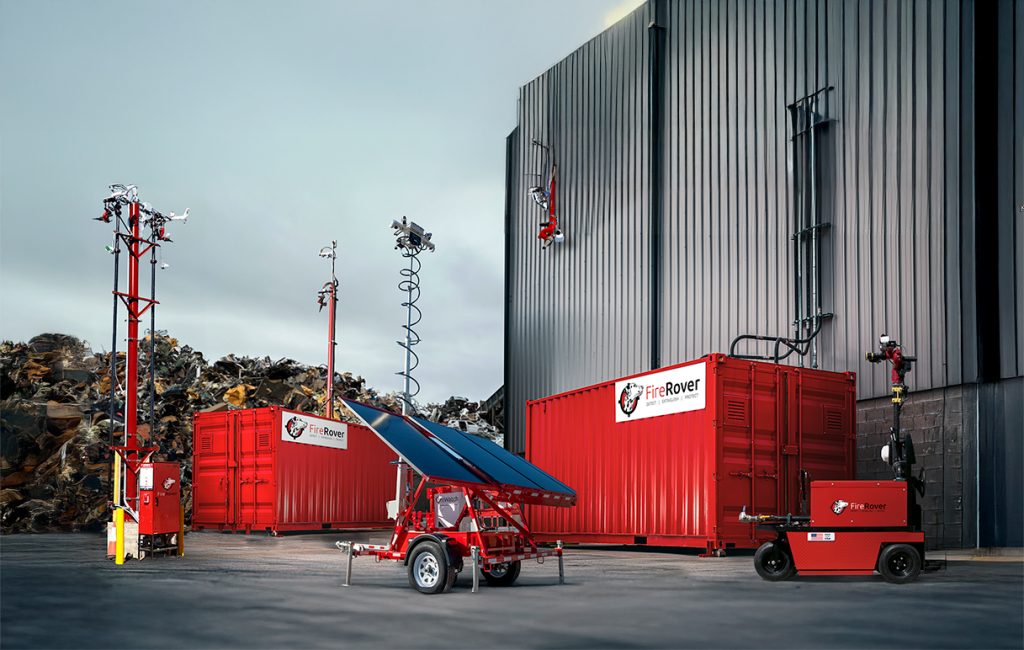
Waste and recycling facilities store large volumes of mixed, combustible material, often outdoors or in tall buildings, and receive loads whose contents nobody fully knows. It is no surprise that fires are frequent. The goal of fire protection here is not only to put fires out, but to find them while they are still small.
Why fires start
- Lithium-ion batteries in discarded electronics, toys and vapes. Crushed or punctured cells can go into thermal runaway in a truck, on a tipping floor, in a shredder or days later inside a pile.
- Hot loads — ashes, embers or reactive chemicals delivered with the waste.
- Self-heating of organic material as it decomposes, especially in large, compacted piles.
- Friction and sparks from shredders, balers and conveyors.
- Hot work and vehicle faults.
Why conventional systems struggle
Ceiling-mounted smoke and heat detection responds slowly in tall buildings and not at all outdoors. Sprinklers need heat at the ceiling to operate, by which time a pile fire may be deep-seated. Dust and moving vehicles cause false alarms for many detector types. Fires that start inside a pile may smoulder for hours before showing at the surface.
Early detection with thermal imaging
Thermal cameras measure surface temperature across whole piles, bunkers and tipping floors. Rising temperature or a hot spot can be flagged long before flames appear. Combined with flame and smoke analytics from video, and with human verification of each alert, thermal detection gives early warning with few false alarms. It does not see through a pile, so it works best together with good pile management.
Targeted suppression
Once a hot spot is confirmed, a remotely aimed monitor or cannon can apply water or a suppression agent exactly where it is needed. Compared with flooding an area, this uses much less water, limits damage to stock and equipment, and reduces contaminated run-off. Mobile units can protect temporary stockpiles, construction phases and hot work.
Pile management: the foundation
- Limit pile height and volume, and keep separation distances or fire walls between piles
- Rotate stock so material does not sit and self-heat
- Monitor temperature inside large piles with probes where appropriate
- Keep access routes clear for firefighting and turning piles
- Quarantine suspicious loads and remove batteries at the earliest stage
Batteries need special attention
Lithium-ion fires can reignite after they appear to be out and release toxic, flammable gases. Sites that handle batteries need a designated, monitored quarantine area, staff trained to recognise damaged cells, and a clear procedure for isolating and cooling a battery fire.
Building a protection concept
- Survey the site: material types, pile sizes, buildings, water and power.
- Identify zones where early detection matters most: tipping floor, bunkers, shredders, balers, conveyors, outdoor storage.
- Design coverage for cameras and suppression reach, including night-time and weather conditions.
- Integrate with the building fire alarm, gas detection and site emergency plan.
- Train and drill operators and responders.
How ZE-Tronics helps
We survey sites, design early detection and suppression, and supply and support systems from Fire Rover, which combines thermal imaging, operator verification and remotely operated suppression. We integrate them with fire alarm and gas detection systems and train site teams. See our industrial solutions or contact us to discuss your facility.
Frequently asked questions
Why are there so many fires at recycling plants?
Mixed combustible material, lithium-ion batteries hidden in waste, hot loads and self-heating piles all create ignition sources, while large volumes and tall buildings make fires hard to detect early.
Can thermal cameras see fires inside a pile?
No. They measure surface temperature. Fires deep inside a pile are found through surface heating, temperature probes and good pile management.
Do sprinklers work in waste facilities?
They help, but in tall buildings they may activate late and they do not protect outdoor stockpiles. Early detection and targeted suppression are usually added for high-risk areas.
How should damaged lithium-ion batteries be handled?
Separate them as early as possible into a designated, monitored quarantine area, and have a clear procedure for isolating and cooling a battery if it heats up.