Azərbaycan
  Русский
 Lifecycle Maintenance & Support
Preventive and corrective maintenance, proof testing, obsolescence management, spares holding and emergency call-out, backed by our own electronics repair laboratory.
A fire and gas system degrades quietly. Sensors drift within tolerance until they don’t. Optical windows accumulate film. Batteries lose capacity. Firmware falls out of support. None of it announces itself, and the system continues to display “normal” throughout.
The only defence is a maintenance regime built on the actual failure characteristics of the installed equipment — and executed on schedule, not when the schedule permits.
Preventive maintenance
Proof testing. IEC 61511 requires safety instrumented functions to be proof-tested at the interval assumed in the SIL verification calculation. If verification assumed annual testing and testing happens every two years, the achieved SIL is not the claimed SIL — and the gap is invisible until it matters. We execute proof tests to documented procedures and record results in the form your auditor expects.
Detector calibration. Scheduled calibration of the fixed and portable population, using our accredited laboratory or on-site as appropriate.
Ex equipment inspection. Periodic inspection to IEC 60079-17 — enclosure integrity, gland condition, earth continuity, corrosion, mechanical damage — recorded on schedules that build a condition history.
Panel and power system maintenance. Battery capacity testing (a battery that passes a voltage check can still fail an autonomy test), power supply verification, relay and contact condition, internal wiring inspection.
Functional testing. Periodic re-execution of the cause-and-effect matrix, verifying the system still does what it did at commissioning. Configuration drifts through modifications, and undocumented changes accumulate.
Optical and mechanical. Flame detector window cleaning and optical path verification, open-path alignment, sinter and flame arrestor cleaning, suppression system pressure and weight checks.
Our electronics repair laboratory
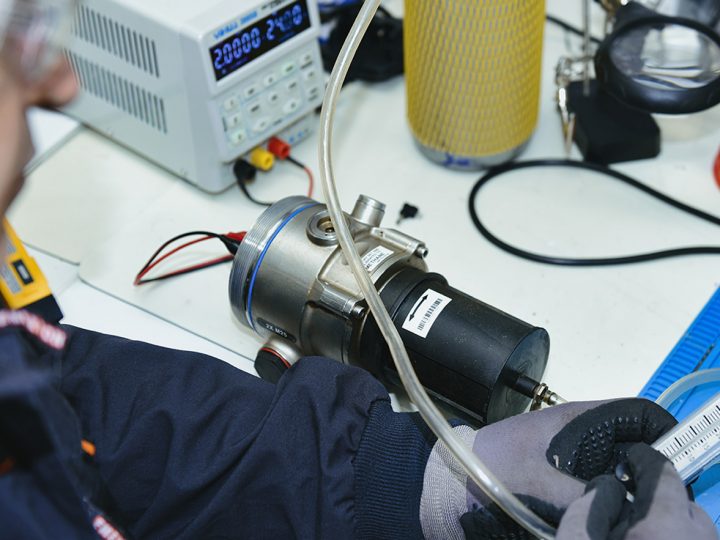
Most integrators return a failed device to the manufacturer and wait. We operate our own electronics repair laboratory in Azerbaijan:
- Repair of flame, gas and smoke detectors
- Diagnostics of control controllers
- Restoration of electronic modules and boards
Combined with local spares holding, this changes the arithmetic of a failure from weeks to days.
The economics of local support
Conventional model: Manufacturer → foreign service organisation → long wait.
Our model: Manufacturer → ZE-Tronics → you. Faster service, shorter downtime, lower operating cost, and a local technical knowledge base that stays with your asset.
Obsolescence management
Industrial safety equipment routinely outlives its product line by a decade or more. We monitor manufacturer lifecycle announcements for equipment we support, give advance warning when a product moves toward end-of-life, advise on last-time-buy spares strategy, and plan migration paths that phase replacement across budget cycles rather than forcing a single large capital event.
Compliance reporting
Every visit produces documentation suitable for regulatory inspection: what was tested, what was found, what was corrected, what remains open, and when the next intervention is due. At contract level we provide a consolidated annual report giving your HSE team an evidenced position on system health rather than an assumption.
Frequently asked questions
Can you maintain systems you did not install?
Yes. We would begin with a baseline condition survey, because a maintenance regime built on unknown starting condition is not a regime.
What if our documentation is incomplete or lost?
Very common in older assets. We can reconstruct the essentials through survey and testing — device schedule, verified cause-and-effect behaviour, area classification review — and produce a maintainable baseline.
Can maintenance be scheduled around turnarounds?
Yes, and it usually should be. Planning around your shutdown windows minimises impairment periods and avoids production impact.